Solo City Break Travel Guide: Dinant, Belgium


A solo city break travel guide to Dinant: clifftop citadels, honky biscuits, a trail of painted saxophones, and 408 steps that will test your lungs; all an hour from Brussels.
There are towns that look good in photos, and then there are towns that genuinely stop you in your tracks when you round the final bend of the Meuse. Dinant is the latter. Squeezed between a slow-moving river and sheer limestone cliffs, with a Gothic church that seems to have grown straight out of the rock face and a fortress looming 100 metres above your head, it announces itself with a confidence that belies its modest size.
I visited on a solo day trip from Antwerp, which at over two hours each way, with a couple of changes, is a commitment. Worth it? Absolutely. In fact, the train from Brussels North takes just over an hour and is the obvious jumping-off point for most visitors. If you're planning a solo city break and wondering where to go, Dinant belongs near the top of the list. But wherever you board, it's the sort of place that sends you home wanting more time, not less. Here is my Dinant travel guide to this beautiful Belgium city.
Essential facts about Dinant
Language: French (Wallonia)
Best season: April – October
Citadel entry: €14 adults (varies by season)
How to get to Dinant
By train
Dinant is straightforward to reach by rail. From London you can either catch the Eurostar to Brussels or Flix Bus. Then from Brussels, the simplest route runs from Brussels-Luxembourg station (not Brussels-North or Brussels-Midi, though these connect easily) down through Namur and along the Meuse valley; a journey that becomes increasingly pretty the closer you get. The train station in Dinant sits right in the town centre, a five-minute walk from the riverfront. You can book tickets through the Trainline app and cost around £25 return. Make sure to print your ticket as digital copies are sometimes not accepted.
Why Dinant?

What makes it worth the journey
Most Belgian day-trip destinations have one or two things going for them. Dinant has five or six, and they happen to complement each other neatly. The history is serious; this town has been sacked, shelled, occupied, and rebuilt repeatedly since the 7th century, but the atmosphere today is cheerful and unhurried. It's small enough to cover in a day yet layered enough that you'll still find something you missed.
"The first time I saw Dinant it literally took my breath away. What was meant to be a quick side trip turned out to be my favourite stop in Belgium." A common sentiment among first-time visitors
The town earns its place on the map through a combination of dramatic geography, medieval fortifications, a genuinely fascinating story about one very inventive local, and the happiest bridge in Belgium. Let's take it in order.
Local legend of Dinant
Adolphe Sax and the instrument that changed music Adolphe Sax was born in Dinant on 6 November 1814. Despite revolutionising music, he died penniless in Paris in 1894 — never witnessing how jazz would elevate his invention to icon status.

Antoine-Joseph "Adolphe" Sax grew up in a family of instrument-makers on a street that now bears his name. He was, by all accounts, a compulsive tinkerer: by his twenties he had already improved the bass clarinet and was working on an instrument that would combine the projection of a brass instrument with the fingering of a woodwind. The saxophone was patented in 1846, and it changed everything, from military bands to orchestras to jazz.
He spent much of his working life in Paris and died there, broke and largely unrecognised. It's one of the great injustices of musical history. Dinant, to its considerable credit, has made amends.
Start at the Maison de Monsieur Sax on Rue Adolphe Sax. This is built on the exact spot where Sax was born, and it functions less like a traditional museum and more like an interpretive centre, which is the right call. There are exhibits on his inventions, the evolution of the saxophone, and the broader family legacy of instrument-making. Saxophone music drifts through the rooms. The bronze statue of Sax outside, seated on a bench with a saxophone in his lap, is an irresistible photo opportunity. Best of all: admission is free, and it's open daily from 9am to 7pm.

Don't go expecting a sprawling gallery; this isn't the V&A. It won't take you more than 45 minutes. But it gives the rest of the town's saxophone references the context they need to land properly.
Open-air exhibit
The trail of saxophones through town
Once you leave the Maison de Monsieur Sax, you'll start noticing them everywhere. Dinant has embraced its musical identity wholeheartedly, and the result is one of the more joyful pieces of public art in Belgium.
The centrepiece is the Pont Charles de Gaulle; the main bridge over the Meuse, named for the future French president who was shot in the leg during the Battle of Dinant in August 1914 as a young lieutenant. (There's a statue of de Gaulle at one end of the bridge commemorating this.) But what you'll notice are the 28 large, colourful, stylised saxophones lining both sides of the bridge, each one decorated to represent a different European country. They were installed in 2010 as a tribute to Adolphe Sax and to the European Union. Walk across slowly, each one rewards a look.
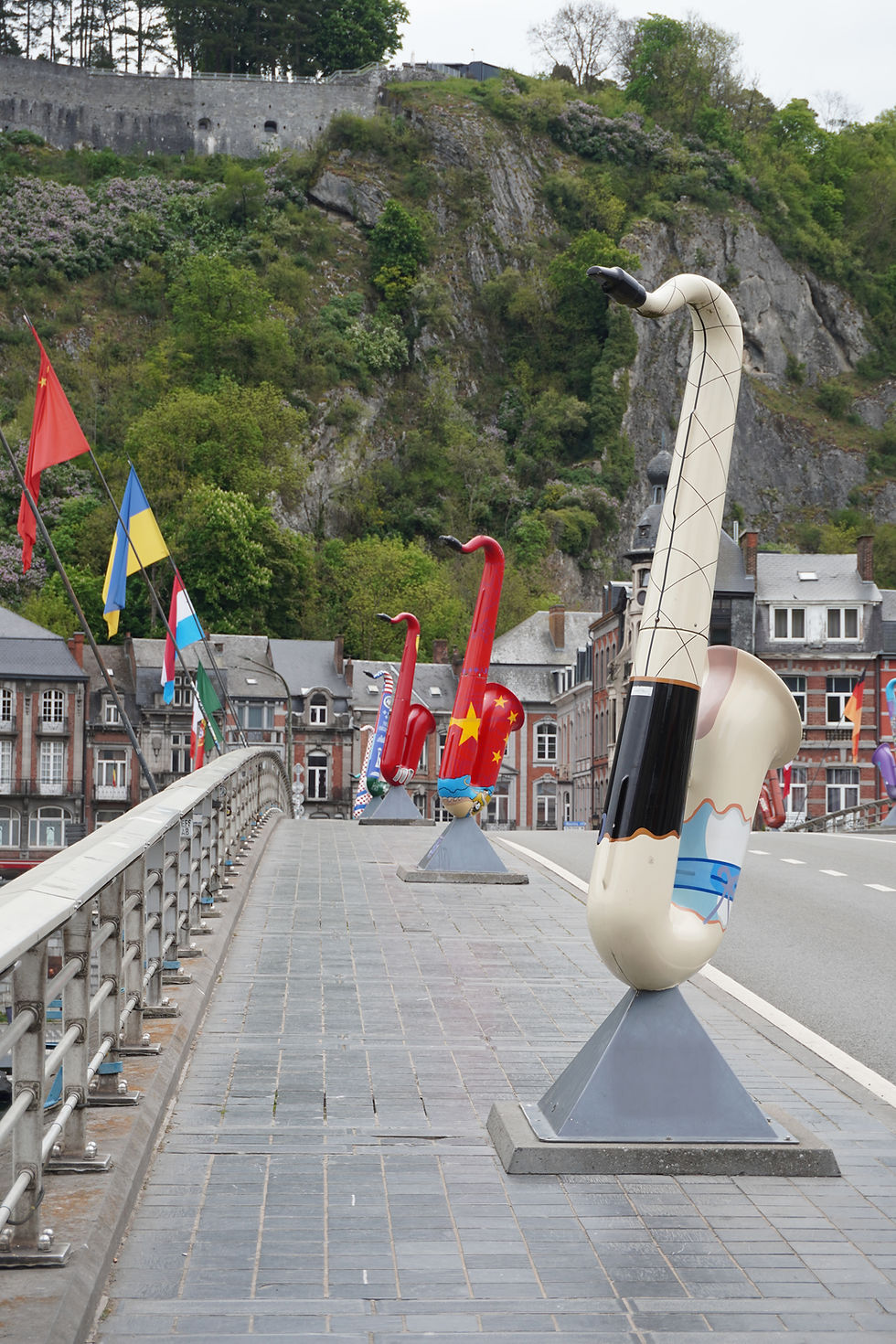
Beyond the bridge, there are around 70 saxophone sculptures and installations scattered through the streets. Some are painted resin, some are bronze, some are almost hidden in odd corners. The town unofficially dares you to find them all. There's no official map, half the fun is stumbling across them as you wander.
The main event of Dinant
The Citadel; fortress, views, and that staircase 408 Stone steps to the top!

The Citadel of Dinant perches on a limestone cliff roughly 100 metres above the river. There have been fortifications on this spot since the 9th century, though the current structure was largely rebuilt by the Dutch in 1815–1821. It's imposing from below; you'll barely take your eyes off it from the moment you arrive at the station and extraordinary from above.

You have two options for ascent: the cable car (recommended if you want to save your legs for the afternoon. However this was closed on the day I visited), or the 408 stone steps that zigzag up the cliff face. The stairs are entirely doable, thousands of visitors manage them every year, but don't underestimate them on a warm day. It is, genuinely, a mini workout. Plan to arrive huffing and puffing, pause at the top to catch your breath, and take a moment to appreciate that people used to do this in chainmail.
Inside, the experience goes well beyond the view. The Citadel contains dungeons, medieval kitchens, a carriages and weapons museum, and an immersive recreation of a First World War trench and shelter. Dinant was heavily bombarded in 1914 and the scars of that period are woven into the exhibits thoughtfully.
There's also an augmented reality guide that brings the fortifications to life as you move through the site, you point your device at various points around the walls and the history layers itself over the present. It's one of the better uses of AR in a heritage setting, particularly for visitors who find wall panels less engaging than interactive storytelling.

And then there's the famous wonky room, a small chamber where the floor, walls, and ceiling are built at subtly wrong angles, which means you end up walking sideways and your sense of balance goes haywire. It's genuinely disorienting in a way that photos fail to convey. Go slowly.

The views from the ramparts, needless to say, are extraordinary, the full sweep of the Meuse Valley, the coloured rooftops below, the church dome, the bridge with its saxophones, the cliff-faces across the river. Give yourself time up here.

A combined "3-in-1 Formula" ticket covers the Citadel, cable car, and a river boat trip for around €22 per adult, which is good value if you're planning to do all three.
There's a café at the top that is reasonably priced for snacks or a drink.
Check opening hours and seasonal closures at the Citadel's website before you travel.
While you're in Dinant: The church, the river, and the town at water level

The Collegiate Church of Notre-Dame (also called the Collégiale Notre-Dame de Dinant) is the first thing you see from the train and the last thing you photograph before you leave. Its distinctive pear-shaped (some say onion-shaped) bell tower is a 16th-century addition that ended up here almost by accident: it was originally designed for the town hall, and only arrived at the church after a fire in 1554. The building itself is Gothic, dating to around 1227, though it's been rebuilt so many times that the interior is pleasantly eclectic. It's free to enter.

The church sits right at the base of the cliff, wedged between the rock face and the river promenade, which gives the whole scene an almost theatrical quality, as if someone designed the town as a stage set and forgot to leave room for ordinary life.
For a completely different perspective on all of this, take a river cruise on the Meuse. Croisières Mosanes offers trips ranging from 45 minutes to two hours, and seeing the church, the cliff, and the citadel above from the water makes the whole "town squeezed between river and rock" geography suddenly legible. It's peaceful, the photo angles are excellent, and it's one of those things that sounds optional but isn't really.
What to eat in Dinant: Bakeries, waffles, crêpes and the biscuit that fights back
Local specialty: Couque de Dinant
A rock-hard honey biscuit made from just two ingredients: honey and flour. Stamped into elaborate moulds; animals, saints, crowns, and baked until improbably solid. More souvenir than snack. Your dentist may not approve.

Sweet stops: Waffles & crêpes
Belgium does waffles better than anywhere, and Dinant is no exception. The riverside cafés and bakeries along the promenade are well set up for a solo traveller wanting to sit, watch the Meuse, and eat something warm and excellent.
Boulangeries: Pastries & café culture
Pop into any boulangerie for flaky pastries and a strong coffee. The French-speaking south of Belgium takes its bread and patisserie seriously; a strawberry chantilly puff here is as good as anything you'd find across the border.

The couque de Dinant deserves special attention because it is, honestly, one of the more confronting things you'll eat in Belgium, and that's saying something. Traditionally made with only honey and flour (no butter, no eggs, no mercy), these biscuits are stamped into decorative shapes and baked until they achieve a hardness that would embarrass most building materials. They are proudly sold in every bakery and gift shop in town. Buy several. They keep for months. Your friends will be confused and slightly worried when you give them one.
For vegetarians, Dinant's café culture is your friend. The town's boulangeries are excellent for a mid-morning pastry stop, and the riverside crêperies and waffle stands make an easy, satisfying lunch that doesn't require a reservation or a companion to split a pot of mussels with. Grab a table facing the Meuse, order a liège waffle with fruit, and watch the tourist boats go by.
Solo Dinant Travel Guide Tip
Practical travel notes for the day
Dinant is an excellent solo destination. The town is compact, the sights are all self-guided or drop-in, and there's no awkwardness eating or wandering alone. The riverside cafés have single tables facing the water by design.
Dinant is French-speaking. You're in Wallonia, the southern part of Belgium. Basic French phrases go down well, though English is widely understood in tourist areas.
The town is compact and almost entirely walkable. You won't need a taxi or bus between the main sights.
If you're coming from Brussels, consider the direct trains from Brussels-Luxembourg station rather than Brussels-North. They tend to be faster and require fewer changes.
Summer weekends can be busy. Arriving on the first train of the day gives you the town largely to yourself for the first hour or two. A real advantage as a solo visitor.
The river cruise is seasonal, typically April through October. Check availability if you're visiting outside those months.
If you're coming from Antwerp (as I did), factor in the extra travel time generously. The 2+ hour journey is worth it, but arriving mid-morning rather than at noon makes a real difference to how much you can fit in. I would recommend around 8-10 hours in this city, including dinner and river cruise which can be anything from 45 minutes to 2 hours, depending on route.
I would also recommend visiting the Maison Leffe, one of the most famous beers in Belgium. This costs €15,00 per visit which includes an interactive tour of Maison Leffe, tasting and a gift, lasting up to an hour. Pre-booking is advised.
Final Thoughts on Dinant
Should you go?
Yes. Plainly and without qualification: yes. Dinant is one of those places that photographs cannot fully prepare you for, because the photographs can't convey the scale, the way the cliff looms, the way the church seems impossibly close to the rock face, the way the whole town seems to exist in defiance of sensible urban planning.
It's a town built on a story: one very inventive man, one revolutionary instrument, one instrument that changed the sound of the 20th century. That story is told with real warmth here, in the free museum, the bridge, the street sculptures, the way the saxophone has become the town's unofficial mascot. And then the history underneath all of that is genuinely serious: the Citadel's exhibits on medieval warfare and the First World War trench reconstruction remind you that this landscape has seen things that the cheerful painted saxes on the bridge are quietly bookending.
A day from Brussels is exactly the right amount of time. A day from Antwerp requires commitment, but rewards it. Bring comfortable shoes, an appetite for honey biscuits, and lungs willing to negotiate 408 steps. The view at the top is worth every one of them.


Comments